The opening range
In Lesson 4 you met the open: the first RTH price at 8:30 a.m. CT. This lesson is about what happens right after it. In this course, the high and low of the first stretch of RTH have their own name: the opening range.
Why the open is a special moment
ES, NQ, MES, and MNQ trade nearly around the clock on Globex. So why should one moment in the morning matter?
Because at 8:30 a.m. CT (9:30 a.m. ET), the NYSE holds its opening auction and the core trading session for U.S. stocks begins. Before that moment, the futures trade while most of the stocks inside the S&P 500 and Nasdaq-100 are not yet in their main session. After that moment, the stocks and the futures are trading together.
That makes 8:30 a.m. CT a natural dividing line in the day, which is why traders treat the first minutes after it as their own chapter.
What the opening range is
“Opening range” is this course’s term, not an exchange definition. It is simply:
- the opening range high: the highest price traded in the first part of RTH, and
- the opening range low: the lowest price traded in the same window.
This course does not fix a length: you choose the window and use the same one every day. A related term from market profile is the initial balance. TradingView’s TPO indicator help page defines the initial balance range as the range of prices visited during the first time blocks of the session; its blocks are 30 minutes long by default, and you choose how many blocks count.
A worked example
These prices are made up for practice. They are not real quotes.
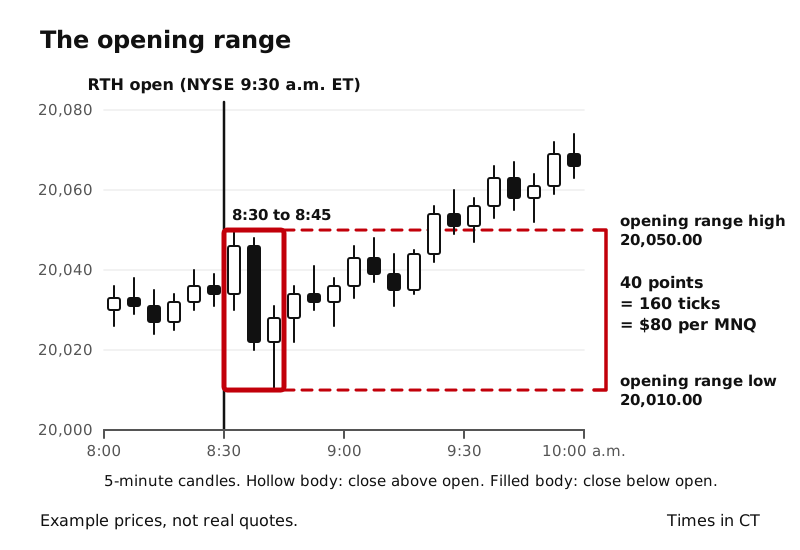
Say you use a 15-minute opening range on MNQ, so your window is 8:30 a.m. to 8:45 a.m. CT. During those 15 minutes, the highest trade is 20,050.00 and the lowest is 20,010.00.
- Opening range high: 20,050.00
- Opening range low: 20,010.00
- Size of the range: 20,050.00 minus 20,010.00 = 40 points
From Runner Lesson 6, a point is 4 ticks and one MNQ point is worth $2. So the range is 40 times 4 = 160 ticks, or 40 times $2 = $80 per MNQ contract from top to bottom. Measuring the range in points and dollars helps you get a feel for how much the market is moving that morning compared to other mornings.
How the opening range fits on your map
Once the window closes, the opening range high and low become two more reference levels, like the ones in Lesson 4. You can describe what price does relative to them:
- Price is inside the opening range.
- Price is above the opening range high.
- Price is below the opening range low.
That is a description of where the market is, nothing more. Price can leave the range and come straight back. It can sit inside the range for hours. As CME’s support and resistance lesson reminds you, levels are zones and they do not always hold.
Common beginner mistakes
- Changing the window every day. If you use 15 minutes on Monday and 30 minutes on Tuesday, you cannot compare mornings. Pick one and keep it.
- Forgetting the overnight session. The opening range only covers RTH. The overnight high and low from Lesson 4 may be far above or below it, and they still matter for context.
- Treating it as a signal. The opening range is vocabulary. Plenty of trading strategies are built on it, but this course does not teach strategies. Here you are learning to name what you see.
Key ideas
- The opening range is the high and low of the first part of RTH, starting at 8:30 a.m. CT.
- 8:30 a.m. CT matters because the NYSE core session (9:30 a.m. ET) opens then.
- This course does not fix a length; choose a window and use the same one every day.
- Measure the range in points, ticks, and dollars to compare one morning with another.
- The opening range is a reference, not a signal.