Stop placement
You now have a risk-per-trade number. The next question is where your stop goes. Beginners usually answer with a dollar amount: “I’ll put my stop $50 away.” This lesson explains why that is backwards.
In Order Filler you learned what a stop order is and how it behaves. Here we deal with the thinking behind where to put it.
The job of a stop
Every trade starts with a reason. “I think price will go up because…” The reason might be a level you marked, the trend, or anything else from Floor Trader. None of those is a signal by itself, and this course does not teach you which reasons to trade. But whatever your reason is, it can be proven wrong by price.
A stop has one job: get you out when the market has shown your reason is wrong.
So the right question is not “how many dollars can I lose?” It is: “At what price is my idea clearly wrong?” That price, plus a little room, is where the stop goes.
An example
The prices below are made up for practice, not real quotes, and this is not a trade idea.
Suppose your reason for a long trade on MES is that price is holding above a level you marked at 6,000.00. If price trades back down through that level and keeps going, your reason is gone.
- Price where the idea is wrong: clearly below 6,000.00.
- You allow a little room for normal wiggle: stop at 5,997.75.
- Entry: 6,003.00.
- Stop distance: 6,003.00 minus 5,997.75 = 5.25 points.
Now turn it into dollars per contract with Runner Lesson 6’s value: MES is $5 per point, so 5.25 times $5 = $26.25 per contract.
Notice the order of the steps: idea first, then stop price, then dollars. The dollars come out of the stop, not the other way round.
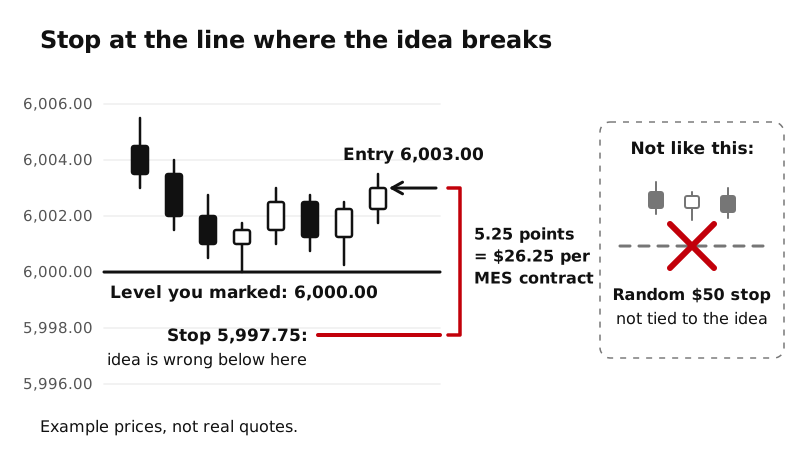
Why a random dollar stop fails
A dollar stop ignores the chart. Take a “$50 stop” on MNQ. At $2 per point, that is 25 points from entry. Two things can go wrong:
- Too tight. The 25-point spot may sit in the middle of ordinary back-and-forth movement. You get stopped out even though your idea was never proven wrong.
- Too loose. Your idea may be clearly wrong after 10 points, but the $50 stop keeps you in for 25. You lose more than the idea ever needed.
Either way, the stop has nothing to do with the reason you took the trade.
When the stop costs more than you want to risk
Sometimes the honest stop is far away. Say your risk per trade is $20 and the stop in the example above costs $26.25 on one MES contract. You have two good choices and one bad one:
- Good: use fewer contracts, or a smaller contract. Lesson 4 shows the math.
- Good: skip the trade. Not every idea fits your account.
- Bad: move the stop closer so the dollars fit. Now the stop is no longer where the idea is wrong. You have turned a sensible trade into one likely to be stopped out by noise.
Rules for the stop once you are in
- Place it when you enter. Decide the stop before the trade, not after it starts going against you.
- Never move it further away. Widening a stop raises your risk above your plan. It is one of the fastest ways to turn a small loss into a large one.
- Know that it is not a price guarantee. FINRA explains that a stop order becomes a market order once triggered and may fill at a price markedly different from the stop in a fast market. FINRA is writing about stocks, but the mechanism is the same idea you met in Order Filler. The CFTC’s risk disclosure adds that in some conditions it can be hard or even impossible to exit a futures position at all.
Key ideas
- A stop belongs where your reason for the trade is proven wrong, plus a little room.
- Work in order: idea, stop price, then dollars.
- A random dollar stop is either too tight (noise) or too loose (extra loss).
- If the honest stop costs too much, reduce size or skip. Do not squeeze the stop.
- Set the stop at entry and never widen it. A stop is not a guaranteed exit price.