Drawdown math
Here is a piece of arithmetic that surprises almost everyone: if your account loses 50 percent, it has to gain 100 percent just to get back to where it started. Once you see why, you will understand the whole point of this level.
What a drawdown is
A drawdown is how far your account has fallen from its highest point. It can be measured in dollars or as a percentage of that high.
Example (made-up numbers): your account peaks at $10,000, then falls to $8,000.
- Drawdown in dollars: $10,000 minus $8,000 = $2,000
- Drawdown in percent: $2,000 divided by $10,000 = 20 percent
Why recovery is harder than the loss
Percentages are always measured from the current balance. After a loss, the balance is smaller, so the same percentage gain is worth fewer dollars.
Walk through the 50 percent case (made-up numbers):
- Start: $10,000.
- Lose 50 percent: $10,000 times 0.50 = $5,000 lost. Balance: $5,000.
- Now gain 50 percent: $5,000 times 0.50 = $2,500. Balance: $7,500. You are still $2,500 short.
- To get back to $10,000 you need to gain $5,000. $5,000 divided by your $5,000 balance = 100 percent.
Losing half is one step. Getting it back means doubling what is left.
The formula
Gain needed to recover = loss divided by (1 minus loss)
Write the loss as a decimal: 20 percent is 0.20, 50 percent is 0.50.
Check it on the 50 percent case: 0.50 divided by (1 minus 0.50) = 0.50 divided by 0.50 = 1.00, which is 100 percent. It matches the walk-through.
Check it on the 20 percent case: 0.20 divided by 0.80 = 0.25, which is 25 percent. From $8,000, a 25 percent gain is $2,000, back to $10,000. Correct.
The recovery table
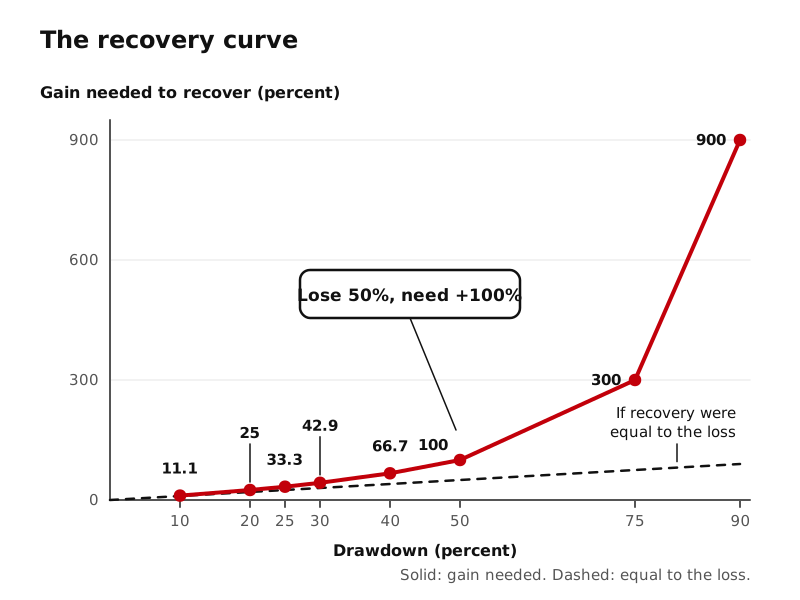
Every row below is the formula worked out (rounded to one decimal place):
| Drawdown | Working | Gain needed to recover |
|---|---|---|
| 10 percent | 0.10 divided by 0.90 | about 11.1 percent |
| 20 percent | 0.20 divided by 0.80 | 25.0 percent |
| 25 percent | 0.25 divided by 0.75 | about 33.3 percent |
| 30 percent | 0.30 divided by 0.70 | about 42.9 percent |
| 40 percent | 0.40 divided by 0.60 | about 66.7 percent |
| 50 percent | 0.50 divided by 0.50 | 100.0 percent |
| 75 percent | 0.75 divided by 0.25 | 300.0 percent |
| 90 percent | 0.90 divided by 0.10 | 900.0 percent |
Read down the right-hand column. At the top, the gain needed is only a little bigger than the loss. Lower down it explodes: lose 75 percent and you must quadruple what is left; lose 90 percent and you need ten times what is left.
What this means for you
Small drawdowns are recoverable. Large ones are a different game. That is the reason behind everything else in this level:
- Risk per trade (Lesson 2) keeps each loss a small slice of the account.
- Position sizing (Lesson 4) makes sure that slice really is small, whatever the stop.
- Daily loss limits (Lesson 7) stop a bad day from adding a big chunk to the drawdown.
Together they aim to keep you near the top of the table, where getting back to even is realistic, and far away from the bottom, where it almost never is.
And remember the worst case. The CFTC’s risk disclosure warns that futures traders can lose all of their deposit and more. At a 100 percent drawdown, there is no gain that recovers the account, because there is nothing left to grow.
Key ideas
- A drawdown is the fall from your account’s highest point.
- Recovery is harder than the loss because gains are measured from a smaller balance.
- Gain needed = loss divided by (1 minus loss).
- 10 percent needs about 11.1 percent; 50 percent needs 100 percent; 75 percent needs 300 percent.
- Keeping losses small keeps you in the part of the table where recovery is realistic.