Moving and trailing stops
A stop is not carved in stone. Once a trade is working, you can change it. This lesson covers how, what the change does to your risk, and how an automatic trailing stop works. It does not tell you when to move a stop; that is a decision for your own written plan, which you will build in the Local level.
Amending a working order
Any order still waiting to fill can be changed or canceled. CME’s Trading Simulator guide shows two common ways, which most platforms copy in some form:
- On the price ladder: click your working order, drag it to a new price, and release.
- In the orders list: choose amend, type the new price in the order ticket, and submit.
CME’s guide even uses this example: a trader who is long and sees the market rise amends the stop to a higher price.
What moving a stop does to your risk
The arithmetic is the same as always: distance in ticks, times dollars per tick, times contracts.
Example prices, not real quotes. You are long 1 MNQ from 20,000.00 with a stop at 19,990.00.
| Stop at | Distance from entry | Worst case before slippage (1 MNQ) |
|---|---|---|
| 19,990.00 | 10 points = 40 ticks | 40 x $0.50 = $20 loss |
| 19,995.00 (moved closer) | 5 points = 20 ticks | 20 x $0.50 = $10 loss |
| 20,000.00 (at entry) | 0 | about $0 before slippage and fees |
| 19,980.00 (moved farther) | 20 points = 80 ticks | 80 x $0.50 = $40 loss |
Moving a stop toward your entry, or past it, shrinks what you can lose. Moving it away from your entry makes the possible loss bigger. CME’s risk lesson describes stops as protection against a loss larger than you can handle, so widening a stop after the trade starts is quietly changing that limit.
A stop moved to your entry price is often called a breakeven stop. It is not truly zero risk: Lesson 6 showed a stop can fill a tick or two worse, and Lesson 11 shows fees are charged either way.
Trailing stops
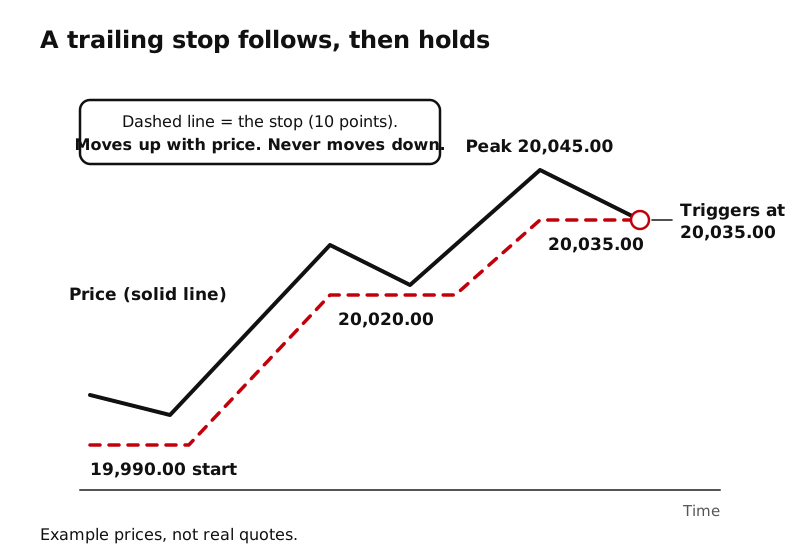
A trailing stop moves by itself. The SEC describes it, for stocks, as a stop or stop limit order whose stop price is set as a fixed amount (or percentage) away from the market. When price moves in your favor, the stop follows it by that amount. When price moves against you, the stop stays put. If price falls back to it, it triggers.
Futures example, with made-up prices (example prices, not real quotes): you buy 1 MNQ at 20,000.00 with a 10-point trailing stop.
- Starting stop: 19,990.00.
- Price rises to 20,030.00. The stop trails up to 20,020.00.
- Price peaks at 20,045.00. The stop is now 20,035.00.
- Price drops. The stop stays at 20,035.00 and triggers when price gets there.
- If filled at 20,035.00, that is 35 points times $2 = $70 on 1 MNQ, before slippage and fees.
The SEC adds two cautions that apply here too: a short, sharp move can set off a trailing stop, and the fill can still be away from the stop price.
Who does the trailing
CME’s list of CME Globex order types has no trailing stop. So on futures, a trailing stop is a feature of your platform or broker: their software watches price and keeps amending your stop for you. That means rules differ between platforms, such as how often the stop updates and whether it keeps working if your platform is closed. Check your platform’s help pages and test it in a simulator first.
A note about moving targets
Moving a resting limit target is different from moving a stop. Under CME’s FIFO matching, changing an order’s price sends it to the back of the queue at its new price (Lesson 5). Move a target often and you keep giving up your place in line.
Key ideas
- Working orders can be amended: drag on the ladder or edit the ticket.
- Moving a stop toward your entry reduces possible loss; moving it away increases it. Do the tick math each time.
- A trailing stop follows price by a set distance in your favor and holds still when price turns.
- On futures, trailing stops are run by your platform or broker, not CME Globex. Test before relying on one.