Trend, range, and chop
Welcome to Floor Trader. In Clerk you learned to read a chart, and in Order Filler you learned how orders work. Now you start learning to describe what the market is doing. The first question to ask about any chart is simple: what kind of market am I looking at?
CME Group’s technical analysis course says charts help traders spot three things: whether a market is trending, possible turning points at tops and bottoms, and periods of consolidation. This lesson gives you plain names for those conditions.
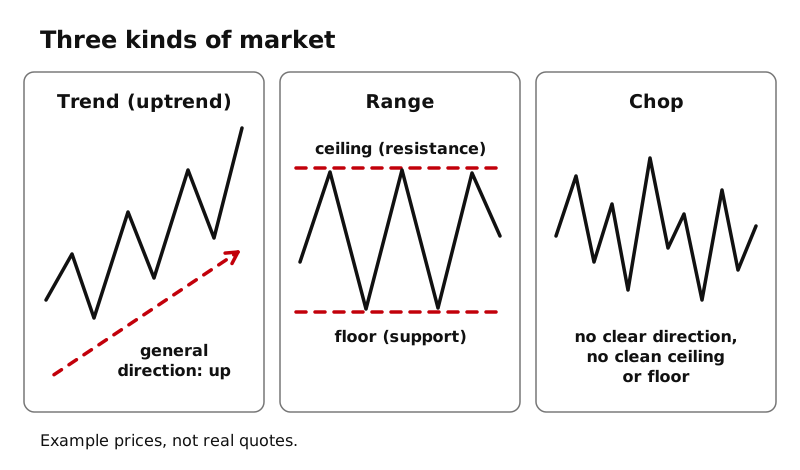
Trend
A trend is a market that keeps making progress in one direction over time.
- In an uptrend, price keeps climbing. Each push up reaches a new high, and each pullback stops above the last pullback low.
- In a downtrend, price keeps falling. Each push down reaches a new low, and each bounce stops below the last bounce high.
Picture walking up a staircase with a few steps back now and then. You still end up higher. That is an uptrend. Schwab’s chart reading guide describes it the same way: a series of higher highs and higher lows is an uptrend, and lower highs and lower lows is a downtrend. Lesson 2 shows you how to define this precisely using swing highs and lows.
CME Group’s course makes an important point: markets never move in one direction forever. A trend is a description of the past, not a promise about the future.
Range
A range is a market moving sideways between a ceiling and a floor. Price rises to roughly the same high, falls back to roughly the same low, and repeats.
CME Group calls this consolidation and describes it as a market that cannot break out of a defined area because neither buyers nor sellers can push price beyond certain levels. On a chart it can look like a rectangle drawn around the price bars. CME also notes there is no fixed rule for how long a range can last.
The ceiling and floor of a range are examples of resistance and support, which you will study in Lesson 3.
Chop
Chop is trader slang for a market going sideways with no clear direction. TradingView’s help page for its Choppiness Index uses “choppy” for a market trading sideways, as opposed to trending in either direction. In this course we use chop for the messy kind of sideways market: price jumps up, then down, then up again, but it makes no real progress and does not respect a clean ceiling or floor either. Bars overlap each other heavily, and direction changes often.
A range is orderly: you can draw the box. Chop is disorderly: the box keeps changing shape. Many traders find chop the hardest condition to read, which is exactly why it helps to have a name for it.
Why the label matters
Naming the market type is not a trading decision. It is a way to organize what you see so the rest of this level makes sense. Many of the tools you will meet later (support and resistance, VWAP, moving averages, volume profile) look and behave differently in a trend than in a range. Knowing which one you are in gives those tools context.
Two cautions:
- The label depends on the timeframe. A 5-minute chart can be in a range while the daily chart is in an uptrend. Lesson 11 covers this.
- The label can change at any time. A range can turn into a trend, and a trend can stall into a range or chop. You only know which one it was for certain after the fact.
Try it yourself
Open any chart on a simulator or charting platform. Scroll back through a few days and, for each stretch of time, say out loud: “trend up,” “trend down,” “range,” or “chop.” You will disagree with yourself sometimes. That is normal. The goal is to build the habit of asking the question before you do anything else.
Key ideas
- A trend makes progress in one direction: up or down.
- A range (also called consolidation) moves sideways between a ceiling and a floor.
- Chop is slang for a sideways market with no clear direction; in this course it means the messy kind, with no clean boundaries.
- The market type is a description, not a signal. It depends on the timeframe and can change without warning.