Risk-to-reward
Every trade has two sides: what you could lose if you are wrong, and what you could make if you are right. Comparing the two, before you enter, is one of the simplest habits in trading. It is called the risk-to-reward or reward-to-risk ratio.
The two distances
You already know the first one:
- Risk: the distance from your entry to your stop (Lesson 3).
The second is new:
- Reward: the distance from your entry to your target, the price where you plan to take profit if the trade works.
Where a target goes is part of your own plan, and this course does not teach you where to put one. Here we only measure.
Working it out
Reward-to-risk = reward distance divided by risk distance.
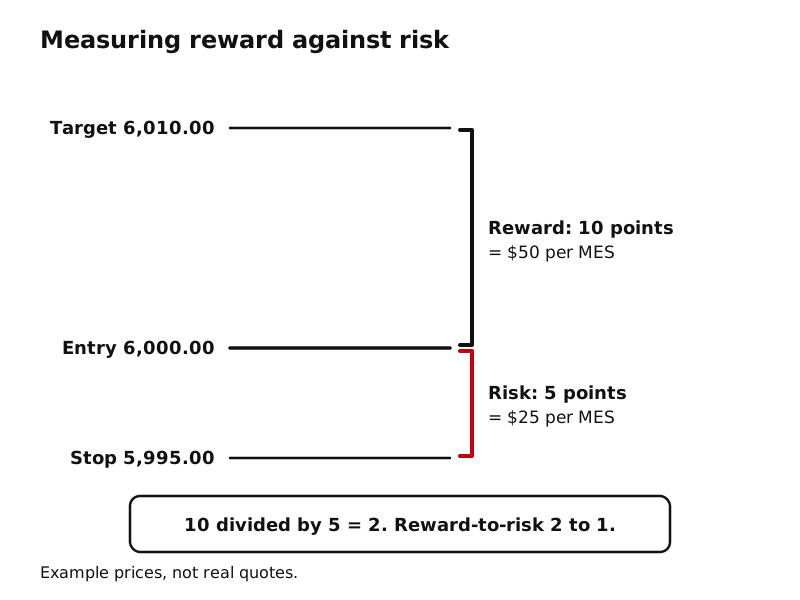
Example on MES (made-up prices, not real quotes, not a trade idea):
- Entry (long): 6,000.00
- Stop: 5,995.00, so risk = 6,000.00 minus 5,995.00 = 5 points
- Target: 6,010.00, so reward = 6,010.00 minus 6,000.00 = 10 points
- Reward-to-risk = 10 divided by 5 = 2, written 2 to 1 or 2:1
In dollars per contract, using Runner Lesson 6’s MES value of $5 per point:
- Risk: 5 times $5 = $25
- Reward: 10 times $5 = $50
- $50 divided by $25 = 2. Same ratio.
That always happens on a single contract: both sides are multiplied by the same dollars per point, so you can measure in points, ticks, or dollars and get the same ratio.
Watch the wording
People write this ratio both ways round, which causes endless confusion:
- Reward-to-risk 2:1 means reward 2, risk 1.
- Risk-to-reward 1:2 means risk 1, reward 2.
Those describe the same trade. In LearnToTick we say reward-to-risk and put the reward first, and when it matters we spell it out: “reward 2, risk 1.” When you read anyone else’s numbers, check which side comes first.
A trade where you risk more than you aim to make is written the same way. Risk 15 points to make 5: reward-to-risk is 5 divided by 15, which is 1 to 3 (reward 1, risk 3).
What the ratio tells you, and what it does not
The ratio tells you how big a win is compared with a loss. With 2 to 1, one full win pays for two full losses.
It does not tell you:
- How often you will win. A huge target is easy to set and may rarely be reached.
- Whether the trade is good. A trade with a great ratio and almost no chance of reaching the target is not better than a modest one.
- Your real result. Stops can fill worse than planned (Lesson 3), and commissions and fees come out of every trade (Order Filler).
To judge whether a ratio is enough, you have to combine it with your win rate. That is exactly what Lesson 6 does, and it explains how a trader who wins less than half the time can still come out ahead.
Moving a target or a stop changes the ratio
Once you are in a trade, it is tempting to “give it more room” by widening the stop, or to grab a quick profit well before the target. Both change the reward-to-risk you planned, usually for the worse:
- Widening the stop from 5 points to 10, with the same 10-point target, drops the ratio from 2 to 1 down to 1 to 1.
- Taking profit at 3 points against a 5-point stop gives 0.6 to 1 on that trade.
You will meet these habits again in Seat Holder. For now, see them as math: they quietly rewrite the plan.
A word on leverage
On paper, the ratio is just two distances. In real money, futures leverage makes both sides bigger than they look on the chart. The CFTC’s risk disclosure statement reminds every customer that leverage can lead to large losses as well as gains. Measure both sides in dollars before every trade.
Key ideas
- Reward-to-risk = reward distance divided by risk distance (target minus entry, over entry minus stop).
- On one contract, points, ticks, and dollars all give the same ratio.
- 2 to 1 means reward 2, risk 1. Always check which side someone puts first.
- The ratio says nothing about how often you win; Lesson 6 combines the two.
- Widening stops or cutting targets early changes the ratio you planned.