Win rate and expectancy
Beginners love win rate. “I win 70 percent of my trades” sounds great. But win rate on its own tells you almost nothing about whether you are making money. This lesson puts win rate and reward-to-risk (Lesson 5) together into one number: expectancy.
All numbers in this lesson are made up to show the math. They are not results from any real strategy, and fees are left out to keep it simple (in real trading, commissions and fees lower every result).
Two words first
- Win rate: the share of trades that win. 4 wins out of 10 trades is a 40 percent win rate. The loss rate is the rest: 60 percent.
- Expectancy: the average amount you make or lose per trade over many trades.
The formula
Expectancy = (win rate times average win) minus (loss rate times average loss)
Write the rates as decimals: 40 percent is 0.40, 60 percent is 0.60.
Trader A: 40 percent winners, reward 2, risk 1
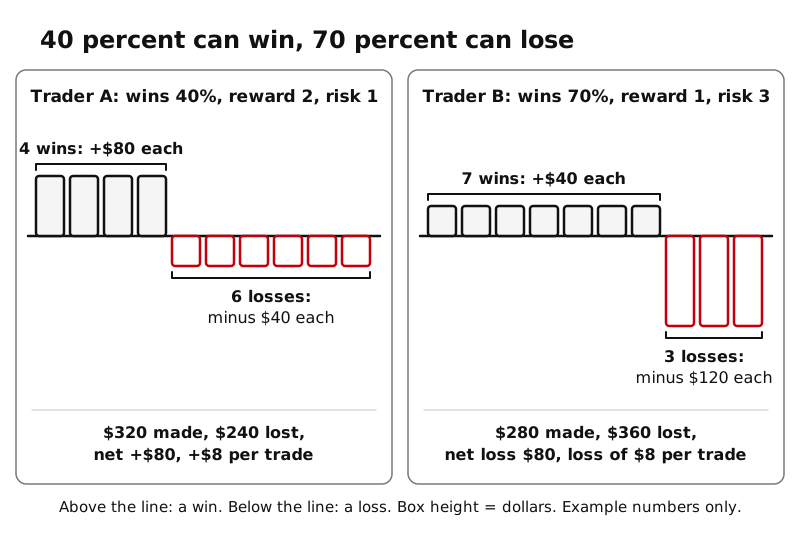
Trader A risks $40 per trade (for example, a 20-point MNQ stop on one contract, from Lesson 4) and aims to make $80 (reward-to-risk 2 to 1). Trader A wins 40 percent of the time.
Over 10 trades:
- 4 wins times $80 = $320 made
- 6 losses times $40 = $240 lost
- Net: $320 minus $240 = $80 profit
- Per trade: $80 divided by 10 = $8
With the formula: (0.40 times $80) minus (0.60 times $40) = $32 minus $24 = positive $8 per trade.
Trader A loses more often than wins, and still comes out ahead, because each win is twice the size of each loss.
Trader B: 70 percent winners, reward 1, risk 3
Trader B takes quick profits and gives losing trades lots of room. Trader B risks $120 per trade to make $40 (reward-to-risk 1 to 3: reward 1, risk 3). Trader B wins 70 percent of the time.
Over 10 trades:
- 7 wins times $40 = $280 made
- 3 losses times $120 = $360 lost
- Net: $280 minus $360 = a loss of $80
- Per trade: $80 divided by 10 = a loss of $8
With the formula: (0.70 times $40) minus (0.30 times $120) = $28 minus $36 = negative $8 per trade.
Trader B wins most of the time, feels good most days, and slowly loses money, because one loss wipes out three wins.
The break-even point
For any reward-to-risk, there is a win rate where expectancy is exactly zero. A quick way to find it: break-even win rate = risk divided by (reward plus risk).
- Reward 2, risk 1: 1 divided by 3 = about 33.3 percent. Win more often than that and expectancy is positive (before fees).
- Reward 1, risk 1: 1 divided by 2 = 50 percent.
- Reward 1, risk 3: 3 divided by 4 = 75 percent. Trader B’s 70 percent falls short of this, which is why Trader B loses.
Check Trader B at exactly 75 percent: (0.75 times $40) minus (0.25 times $120) = $30 minus $30 = $0. Break-even, as predicted.
What expectancy does not promise
Expectancy is an average over many trades. It says nothing about the next one. Trader A, with positive expectancy, will still have losing days and losing weeks, because a 40 percent win rate means long strings of losses are normal. That is why Lessons 2 and 4 keep each loss small: so you can survive the streaks long enough for the average to show up.
Also remember that real numbers move. Fees, worse-than-planned fills on stops (Lesson 3), and the leverage the CFTC warns about in its risk disclosure all push real results below the clean math on this page.
Key ideas
- Win rate alone does not tell you if you make money.
- Expectancy = (win rate times average win) minus (loss rate times average loss).
- 40 percent winners at reward 2, risk 1: positive $8 per trade in our example.
- 70 percent winners at reward 1, risk 3: a loss of $8 per trade in our example.
- Break-even win rate = risk divided by (reward plus risk).
- Expectancy is an average over many trades; streaks of losses are still normal.